Your CRM already exists

Danielle Morrill
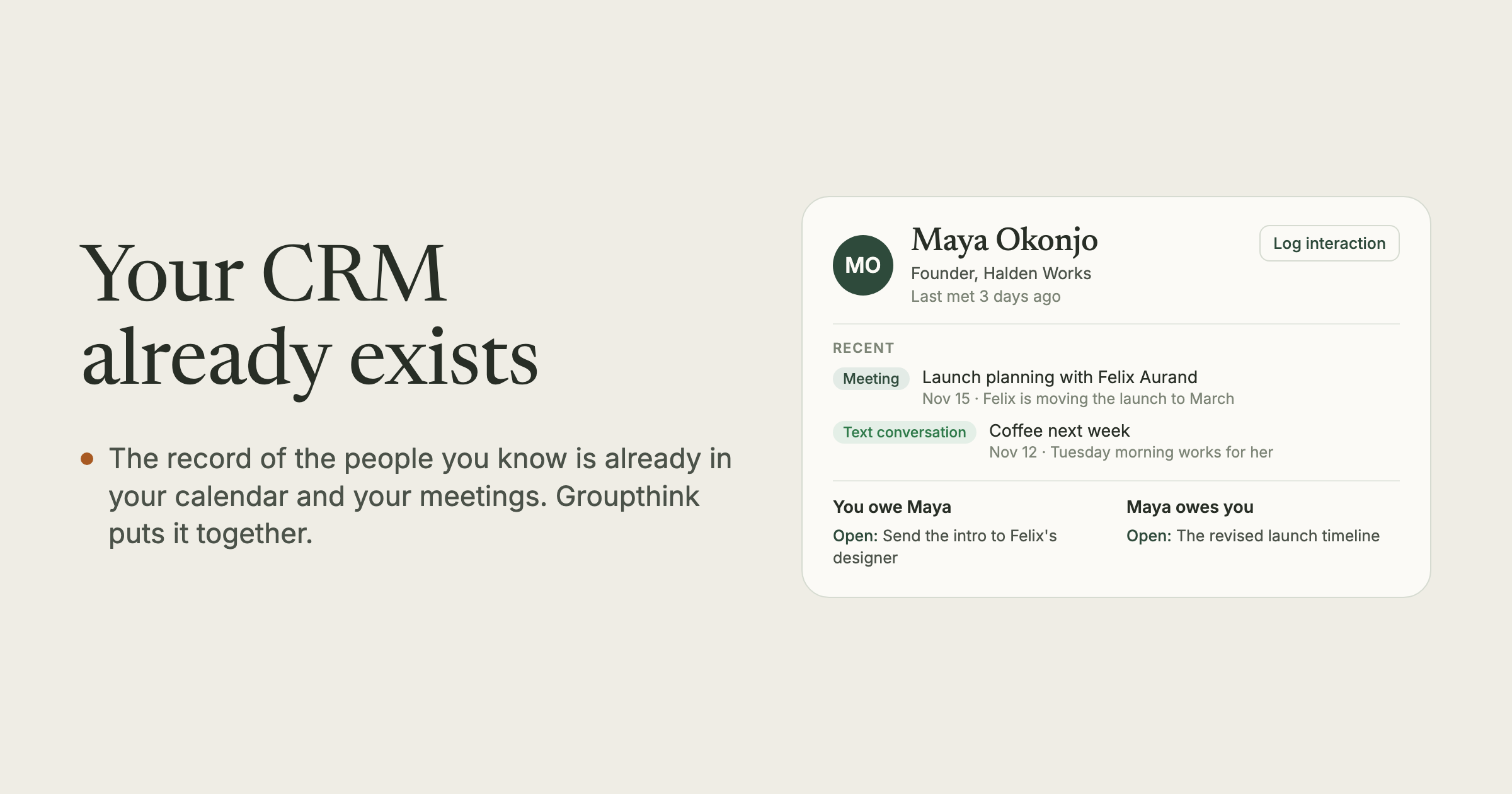
Groupthink is a memory for the people in your life and work. It holds the people in your life and what matters to them, so you show up to every conversation with context.
At Dreamforce in September, Salesforce announced AIforce, which lets people reach their CRM from Slack, from Claude, from an agent, without opening Salesforce at all. Parker Harris said it from the stage: you may never log in to Salesforce again. I think they are right about the interface. Software that makes you go to it, so you can tell it what you already know, is on its way out.
The interface was only ever half the problem. A CRM can log your emails and calls now, but what it builds is a record of the account and the deal. What matters to the person, what you promised them, what they told you over coffee, still waits for someone to type it in after the conversation is over.
Here is what I keep coming back to. The record of your relationships already exists. It is in your calendar, which knows who you met and when. It is in the meetings themselves, where the real content is. It is in your texts, your phone, your inbox. Nothing about your relationships is missing. It is scattered across a dozen places and none of them talk to each other, so the only way to get one view has been for you to sit down and retype your own life into a form.
That is the work we should be deleting.
What fills itself today
Connect a calendar and your meetings come in, with last met, next meeting, and how often you two talk staying current on their own. The notetaker joins on Zoom, Meet, and Teams. On a Mac you can capture privately instead, or hold the fn key and say what happened in a sentence. Already using Granola or Otter or Fireflies? Forward the recap to your Groupthink address and it lands on the right person.
Every one of those updates your relationship with that person. Open someone and you see where things stand, what is still open between you, what you said you would do, and a suggested next move you can act on in a click. The twentieth interaction makes that picture better than the first, which is the part that compounds.
What you type is the small remainder: the coffee nobody recorded, the thing you noticed in standup, the observation that will matter in six months. One sentence, the way you would text a friend.
What is not there yet
I would rather say this plainly than let the pitch outrun the product.
Your inbox is not connected. Email is the single richest record most people have of their relationships, and today Groupthink can only see what you forward to it.
Texts are partly there. On a Mac you can import the Messages conversations you pick, and those keep syncing while the desktop app is running. You can paste any other thread in at any time.
And the record is not zero input. You still choose how often you want to see someone. You still confirm the facts Groupthink pulled out of a transcript before they count as verified, because the alternative is a system that quietly decides things about the people you care about. That confirmation step is deliberate, and it is staying.
Come see
The bet is simple. Everything needed to keep up with the people in your life has already happened. Assembling it is a software problem, not a chore you owe a database every Friday afternoon.
Groupthink is free to start, and the fastest way to feel the difference is to connect one calendar and let a week of meetings land on their own. Then open someone you have known for years and read the arc back.
Remember what matters to make every moment count.